
by WorldTribune Staff, June 4, 2026 Non-AI Real World News
American historical statues that were torn down during the 2020 Antifa/BLM riots are making a comeback.
Some statues have been restored to public view on government orders and the support of residents, while others returned to public view as part of traveling museum exhibits.
“The statue wars that swept away monuments six years ago are back. This time, the battle is to restore them,” the Wall Street Journal noted in a June 3 report.
As the nation’s 250th birthday celebration approaches, the report said, “traditionalists are suing and lobbying local governments to resurrect memorials to Confederate generals, Founding Fathers and European explorers.”
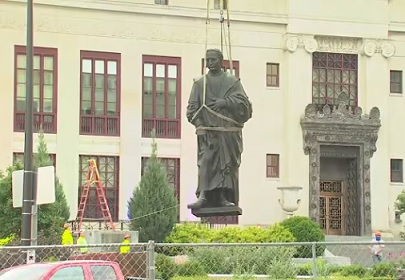
In Columbus, Ohio’s capital which is named for Christopher Columbus, a 22-foot-high, 3-ton statue of the city’s namesake which stood in front of City Hall was removed amid the rioting of 2020. City officials insisted the 1955 gift from sister city Genoa, Italy, had come to represent “patriarchy, oppression and divisiveness.”
“We will no longer live in the shadow of our ugly past,” Mayor Andrew Ginther, a Democrat, said at the time.
In April, a coalition of Italian-American groups filed a federal lawsuit claiming the statue’s removal was illegal and demanding its return.
“The silent majority is becoming vocal,” said Jack Conte, the lawsuit’s organizer. “You reach a point where this stuff is shoved down your throat, and you can only take so much of it.”
In March, the Trump Administration placed a Columbus statue near the White House. It is a replica of one that rioters tossed into Baltimore’s Inner Harbor in 2020.
The Journal noted that the replica “was donated by the Conference of Presidents of Major Italian-American Organizations. The group’s president, Basil Russo—a former Democratic politician from Cleveland—said Columbus had become a scapegoat for Western colonization.”
In a thank-you letter to Russo, President Donald Trump lauded Columbus as “the original American hero and one of the most gallant and visionary men to ever walk the face of the Earth.”
Russo said he could not believe the City of Columbus took down its statue: “It’s the name of their city. What sense does that make?”
The Interior Department recently installed a statue of Caesar Rodney, a Delaware signer of the Declaration of Independence, in Washington’s Freedom Plaza. The monument had been removed from its spot in Wilmington, Delaware by rioters in 2020 who complained that Rodney was a slave owner.
“You either celebrate the 250th and the historic people and events and enter into the drama of the heroic choices made by the revolutionary generation,” said Vince Haley, an adviser to the president on anniversary initiatives, “or leave it to those who would readily distort our history and use it as a political instrument.”
In December 2025, a stone highway marker honoring Confederate Gen. Robert E. Lee suddenly appeared in Marion Square, planted alongside a major thoroughfare in a hub of picnics, farmers markets and celebrations in Charleston, South Carolina.
At a subsequent meeting of the city’s Commission on History, Dale Theiling, one of the commissioners, explained that Charleston had agreed to release the monument to the United Daughters of the Confederacy. The group dropped a lawsuit against the city that it had filed after the statue was pulled from a public school in 2021 and put in storage.
In March, Major League Baseball’s Texas Rangers announced on social media the return to public view of a “One Riot, One Ranger” statue at the ballpark. The 12-foot bronze sculpture of a Texas Ranger had been removed from Dallas Love Field airport during the 2020 riots after claims that the officer who served as the model for the statue—a tribute to the law enforcement agency—sided with opponents to desegregation of a public high school in 1956.
“The Texas Rangers have long occupied a revered place in Texas history dating to the creation of the organization over 200 years ago,” the ball club said when the statue was announced.
Hundreds of comments followed the online announcement.
“Hell yeah need to bust all our history out that’s been stowed away,” one said.
“Racist, bigoted, backward move by the Texas Rangers,” another said.
Back to Columbus. What is now Ohio’s fastest-growing big city was named in the 1800s by a local politician who admired the explorer.
The city’s emblem and its flag display the Santa Maria, Columbus’s flagship, which led the way in the trans-Atlantic voyage of 1492.
“The Columbus Day parade became a civic institution. A wooden replica of the Santa Maria was docked on the Scioto River near City Hall for decades. The Italian Village neighborhood named a park for Columbus. Columbus State Community College had his statue on its campus. At City Hall, the statue of Columbus stood atop a stone pedestal,” the Journal’s report said.
“When I was a kid, Christopher Columbus was a hero,” Conte said. “All these Kumbaya things. After the fifth or sixth one, I went up to the lady, and I said, ‘I thought we were here to talk about the statue?’ ”
The Journal reported that Columbus city meetings “yielded the idea of a new park with a section for the statue and interpretive signs. But there was no funding allocated or location set aside. For Conte, that was the last straw.”
Conte organized the Friends of Christopher Columbus Foundation, enlisting local Italian-American groups. “They’re not listening to anything we’re saying or asking,” Conte said.
Jaime Sisto, an international trade and economic development attorney who backs Conte, said moves to erase Columbus from the city of Columbus piled one on top of the other, “between the renaming of Columbus Day, the Santa Maria, the park, all these things.”
Isaiah Bohanon, 22, who works in marketing, sees the Columbus statue as representing a “historic moment for the Western World.”
“Who is Salmon Chase?” he said, invoking the 19th-century chief justice of the Supreme Court, an Ohioan with a statue at the state capitol. “I’d never heard of him, and he has a statue. But I’ve heard of Christopher Columbus. I think he deserves a statue.”
2026 Contract With Our Readers

Doomed statues stage comeback as nation’s 250th birthday approaches added by Editor Two on
View all posts by Editor Two →