
by WorldTribune Staff, May 13, 2026 Non-AI Real World News
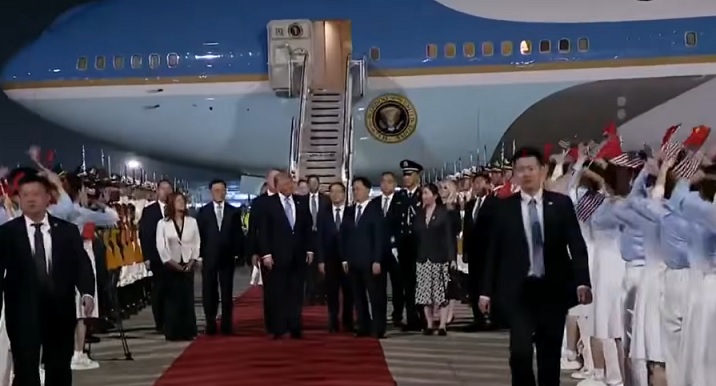
As U.S. President Donald Trump landed in China on Wednesday to ceremonial overload, the communist regime was fixated on a familiar refrain. The Chinese Communist Party (CCP) demands “mutual respect” from the United States.
Should Trump oblige?
“The phrase sounds reasonable, even noble. However, it functions as a demand for silence, acquiescence and moral surrender,” Miles Yu, director of the China Center at the Hudson Institute, wrote in a May 11 op-ed for The Washington Times. Yu is also a former Geostrategy-Direct.com contributing editor.
“More fundamentally, when the CCP demands ‘respect for China,’ it commits a deliberate conceptual fraud on multiple levels.”
• First, Yu wrote, “it deceptively implies that the root of tensions in U.S.-Chinese relations lies in American ‘disrespect’ toward China rather than in Beijing’s own conduct and enmity against the U.S. That includes destructive trade practices, massive intellectual property theft, cyberwarfare against U.S. infrastructure, and fentanyl precursor supply chains fueling mass deaths in America. There is also the rampant espionage, election and misinformation operations and harassment and transnational repression inside the United States, along with enabling any of the world’s leading anti-American regimes — all pursued with an ideological hostility toward the American political system, all part of a long-term strategy to displace U.S. global leadership.”
• Second, “the CCP falsely equates itself with China and the Chinese people, implying that criticism of the CCP is hostility toward China itself, but the CCP is not China. The party has no political or cultural legitimacy. It is an alien imposition on the Chinese people through a radical Western communist ideology that aims to eliminate indigenous Chinese tradition and cultural sinews while institutionalizing the indoctrination of Marxist-Leninist ideology.”
• Third, Yu noted, “by portraying itself as the victim of a disrespectful “American hegemony,” the party weaponizes China’s “Century of Humiliation” at the hands of foreign imperial powers to demand sympathy and obedience from the world. Yet the greatest humiliation inflicted upon China came not from foreigners but from the CCP itself. It took place in the century since the CCP’s founding by Vladimir Lenin’s Comintern agents in Shanghai in 1921, not the century since the Opium War in the 1840s. Ironically, there was indeed a long-standing, subtle form of disrespect toward the CCP from many Western leaders, usually the friendliest ones.”
It was Trump who “first abandoned this Orientalist “China Card” mentality and openly treated the CCP as a primary strategic adversary and peer competitor. For the first time in half a century since President Nixon, Washington recognized Beijing as a central force shaping the global order,” Yu wrote.
“Yet recognition as a major power does not confer moral respectability. No regime deserves international respect while systematically disrespecting the world.”
Hours before it confirmed Trump’s visit to Beijing, the Chinese Foreign Ministry released a short video on X titled “Peaceful Coexistence.” The video calls on China and the United States to “engage in sincerity and good faith.”
“The Earth is too small for China and the U.S. to turn against and confront each other, and the Pacific Ocean is vast enough for both to prosper in their own ways,” the video states, repeating a phrase long used by Communist Party leader Xi Jinping and other Chinese officials.
Xi used similar language during a 2013 meeting with then-U.S. President Barack Obama.
William Chih-tung Chung, an associate research fellow at Taiwan’s Institute for National Defense and Security Research (INDSR), told The Epoch Times that Beijing’s message reflects a long-standing effort to carve out spheres of influence in the Pacific, with the United States dominant in the eastern Pacific and China asserting primacy in East Asia.
“That is China’s strategic ambition,” Chung said. “But this approach is unlikely to work on Trump.”
Chung pointed to the 2025 U.S. National Security Strategy, emphasizing the strengthening of the “First Island Chain” and countering China’s regional expansion. Trump has sought both to block Beijing’s influence in the Western Hemisphere and preserve U.S. dominance in the Indo-Pacific, he said.
2026 Contract With Our Readers

‘Mutual respect?’ CCP greets U.S. president with cognitive barrage added by Editor Two on
View all posts by Editor Two →