
by WorldTribune Staff, August 30, 2026 Non-AI Real World News
Anthony Fauci instructed a subordinate in 2012 to permanently delete an email exchange reacting to a critical media warning about risky virus research, newly released documents show.
In 2011, eight years before Covid and amid the onset of gain of function research, a journalist warned that the program could usher in a “doomsday” scenario and damage the reputation of the National Institutes of Health (NIH).
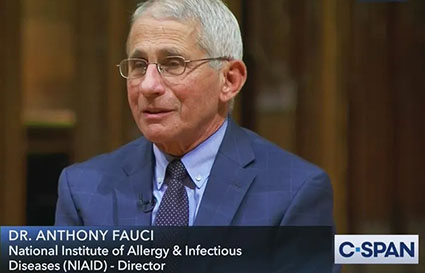 In an email to an aide, Fauci complained about the warning and then instructed the aide to permanently delete the exchange, the documents show.
“The documents add to growing evidence that Fauci destroyed public records despite his sworn testimony that he never did. Deleting government records violates federal law,” The Daily Caller News Foundation reported on Friday.
On June 3, 2024, when questioned by members of the House Select Subcommittee on the Coronavirus Pandemic, Fauci denied under oath ever deleting official records.
Driven by funding from Fauci’s National Institute of Allergy and Infectious Diseases (NIAD), Dutch virologist Ron Fouchier created an airborne strain of a bird flu with an estimated 50% fatality rate, which he described as “probably one of the most dangerous viruses you can make.”
Manmade pandemic viruses are a “risk worth taking,” Fauci insisted in a December 2011 Washington Post commentary, co-authored by National Institutes of Health (NIH) Director Francis Collins and the National Institute of Allergy and Infectious Diseases Vaccine Research Center’s Gary Nabel.
In January 2012, The New York Times published an op-ed apparently written by science writer Phil Boffey which accused the NIH of creating an “engineered doomsday” that could kill “hundreds of millions of people.” The newly released emails reveal the author of the un-bylined op-ed for the first time.
“The consequences, should the virus escape, are too devastating to risk,” Boffey wrote in an apparent reference to Fauci’s op-ed.
The documents show Fauci strongly opposed a recommendation from the NIH’s biosecurity advisors to not publish sensitive details about Fouchier’s experiment.
“Please delete this e-mail and then delete from the deleted file,” Fauci wrote on his NIH email in what critics say is a violation of federal record-keeping laws.
Fauci would go on to persuade the NIH’s biosecurity advisors to allow the Fouchier experiment to be published in full.
When the Covid pandemic hit, Fouchier worked with Fauci and other virologists to downplay the possibility of a lab origin.
Fouchier ghostwrote a key argument in “The proximal origin of SARS-CoV-2,” a paper dismissing a possible lab origin of the virus. Fauci would frequently cite the paper and its authors over the years without revealing he collaborated with them behind-the-scenes.
Yet privately the paper’s authors described Fouchier as “unbelievably conflicted.”
“Ron … is not going to want it to be a GOF [gain-of-function] escape,” one author said.
Fouchier said he didn’t support publicly addressing the possibility of a lab leak in the “Proximal Origin” paper, insisting that it could lead to “harm to science” through renewed debates about biosafety.
“This manuscript would be much stronger if it focused on the likelihood of the first two scenarios as compared to intentional or accidental release,” Fouchier said. “That would also limit the chance of new biosafety discussions that would unnecessarily obstruct future attempts of virus culturing for research and diagnostic purposes for any (emerging/zoonotic) virus.”
250 Years of Freedom Is At Risk

Report: Fauci ordered deletion of emails about ‘engineered doomsday’ Op-Ed added by Editor Two on
View all posts by Editor Two →