
Special to WorldTribune, August 14, 2026 Real World News
Geostrategy-Direct, August 11, 2026
By Richard Fisher
For 20 years the New Zealand origin, now Long Beach, California-based Rocket Lab corporation has developed innovative small space launch vehicles, growing into a space launch service provider and satellite developer, serving commercial and military markets in the United States and other democracies.
On Aug. 6 from its New Zealand Launch Complex-1 (LC-1), Rocket Lab launched the 92nd of its 300-kilogram payload to Low Earth Orbit (LEO) kerolox-fueled Electron space launch vehicle (SLV) — and now Rocket Lab has a SLV launch schedule backlog of over 90 launches.
The Electron SLV also forms the basis for the Hypersonic Accelerator Suborbital Test Electron (HASTE), a sub-orbital SLV that can loft a larger 700-kilogram payload, to test new hypersonic payloads or to provide targets for U.S. ballistic missile interceptors.
On March 18, Rocket Lab announced that along with unmanned aircraft developer Kratos, it had secured a $190 million contract from the U.S. Department of War to support 20 HASTE launches to support programs of the U.S. Navy’s Naval Surface Warfare Center, Crane Division.
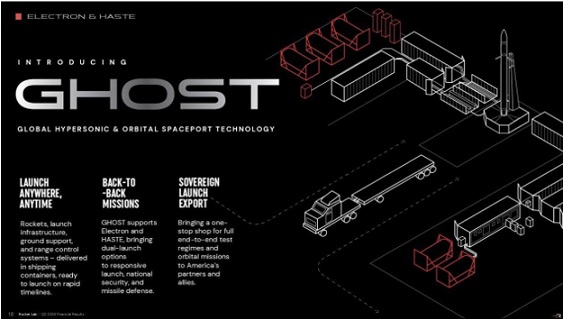
But on Aug. 10, Rocket Lab announced a new “product” that will increase its ability to provide space launch services, called the Global Hypersonic & Orbital Spaceport Technology (GHOST), which is a movable containerized space launch base.
In an Aug. 10 press release, Sir Peter Beck, founder and CEO of Rocket Lab, stated:
“We’ve been leading the field in small launch for missile defense and national security for years. Our reliability, repeatability, and affordability sets us apart from everybody else, and creating GHOST is about packaging that up into a deployable system that can serve the world’s most important programs from wherever those missions need. Whether it’s for missile defense and deterrence, or opening up more trajectories, orbital missions, and sovereign launch capabilities in allied nations, GHOST is the answer to launching anywhere, anytime, and without compromise.”
GHOST would also allow Rocket Lab SLVs to be deployed abroad, for example, to launch small surveillance and communication satellites to rapidly restore vital space-supported combat capabilities to U.S. forces following Chinese or Russian attacks against existing U.S. satellites.
This deployable space launch system could also help U.S. allies like the Philippines to rapidly establish space launch capabilities to support commercial and military launches for the Philippines or for its allies.
Full Report . . . . Current Edition . . . . Subscription Information

Rocket Lab hails its movable ‘GHOST’ space launch base, expanding defense portfolio added by Editor Two on
View all posts by Editor Two →