
Special to WorldTribune.com
 By John J. Metzler, November 6, 2026
Few diplomats expected this. During what has become an annual routine and oft overlooked vote on “Lifting the U.S. Economic Embargo on Cuba,” many delegates would recite an ad nauseam litany of Washington’s “suffocating economic embargo” on the socialist isle of Cuba.
For over thirty years, whopping Assembly majorities condemned Washington and then moved on to the next agenda item.
Until now.
American UN Ambassador Mike Waltz led a concerted State Department counterattack which surprised and stunned complacent delegates which literally ended in a heated shouting match between Amb. Waltz and the communist Cuban Foreign Minister Bruno Rodríguez Parrilla.
When Amb. Waltz addressed the Assembly he began with some history:
“When Fidel Castro seized power, he confiscated businesses, farms, factories, homes, and the savings of generations of hardworking Cubans. Billions in wealth taken, stolen from the people in an instant.”
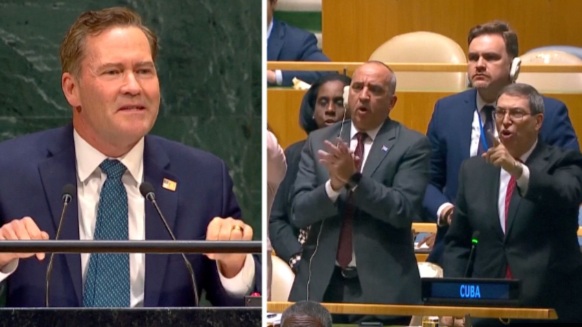
As Waltz was speaking, Cuba’s Foreign Minister and seated members of Havana’s delegation began banging the table and yelling. The American delegate countered:
“I hope everyone, Mr. President, is listening to the delegation right now. Imagine what happens when someone asks questions. Imagine what happens when someone asks these questions in Havana, not in a room full of ambassadors and cameras. Imagine what happens to those people if this is the intimidation and disruption that we see.”
Amb. Waltz directly addressed Cuba’s Foreign Minister:
“Your excellency, I know you don’t like to hear this, this is America, my friend. This is the United Nations. This isn’t your communist dictatorship. You cannot silence me, and you cannot silence my colleagues!”
Despite the near unprecedented yelling in the Assembly chamber, Amb. Waltz pressed his point: “The reality is, he doesn’t like the substance of what he’s hearing. He doesn’t like the hard truths.”
The enraged Cuban diplomats menacingly stormed up to the podium to confront the American Ambassador, who countered:
“Mr. President, this individual needs to back away from this podium. He’s not going to intimidate me in the United States of America like he tries to intimidate political prisoners.”
Waltz added memorably, “I’m the Representative of the United States of America. Back up. Back up, Ambassador. Back away. This isn’t Havana.”
Feathers flew and the session was temporarily suspended by the General Assembly President Rahman. This video went viral!
Amb. Waltz then recited a long list of the widespread corruption of the Castro family and their communist elite running Cuba, profiting off the wealth of the island and giving the crumbs to their people. The country’s wealth had not vanished, he said, but had “simply passed from ordinary Cubans into the hands of the ruling elite.”
The agenda item went through many of the boring talking points on how communist Cuba is being systematically strangled and economically ruined by the U.S. embargo. The formal embargo, not blockade, has prevented U.S. businesses and citizens from conducting trade or commerce with Cuban interests since 1960.
As Amb. Waltz stressed, “There is no blockade. A blockade is a ring of military ships around an island. It doesn’t exist.”
The long-winded resolution, the “necessity of ending the economic, commercial and financial embargo imposed by the United States of America against Cuba” has been a ho-hum hallmark of Assembly sessions for thirty years.
When countries first voted on the resolution in 1992, 59 countries backed the resolution, three opposed it, 71 abstained and 46 did not vote. Interestingly according to UN records, support for the controversial resolution “peaked at 191 votes in favor in 2015, 2016 and 2017, during the thaw in relations under U.S. President Barack Obama.” The United States and Israel voted against in 2015 and 2017; in 2016, both abstained.
Over most years the United States and Israel and perhaps one or two small Pacific states opposed the resolution while a stunning majority of American allies and adversaries ranging from Britain, Canada, and France to China, Russia and Iran support the item.
Though this vote presented an annual embarrassment for Washington, the political consolation rested in the reality that UN General Assembly resolutions are not legally binding.
This year’s vote brought a surprise; The lowest support in twenty years for the embargo resolution.
The text passed by 130 votes in favor to 17 against, with 25 abstentions. Among countries supporting the U.S. besides Israel included Argentina, Colombia, Costa Rica, Ecuador, and Paraguay as well as European allies such as Bosnia-Herzegovina, Czechia (ex-Czech Republic), Hungary, Lithuania, Slovenia and Ukraine.
Washington gained leverage and the American ambassador stood firm for transparency and free speech.

U.S. showdown with Cuba shatters decorum (and boredom) at UN Assembly added by Editor One on
View all posts by Editor One →