
Special to WorldTribune, March 4, 2026 Real World News
By Geostrategy-Direct, March 3, 2026
By Richard Fisher
National Aeronautics and Space Administration (NASA) Administrator Jared Isaacman’s Feb. 27 press conference explaining adjustments in President Trump’s Artemis Moon program gave no hint of the war with Iran that started the next day, but in the struggle for global domination being waged by China and the United States, their relationship is quite direct.
Dominance in space is a first requirement for military-strategic dominance on Earth, which in turn is also necessary to sustain a dominant political-military position in space.
The importance of space access to the U.S. war against Iran was made clear in a March 2 briefing by Chairman of the U.S. Joint Chiefs of Staff Gen. Daniel Caine, who said, “The first movers were U.S. SPACECOM and U.S. CYBERCOM, layering nonkinetic effects, disrupting and degrading Iran’s ability to see, communicate, and respond.”
This meant that that the U.S. Space Command was among the first U.S. military forces to engage and attack Iran’s ability to fight.
Likewise, for Iran and China, access to space was crucial to their ability to fight back.
During the first three days of the war, Iran fired 771 ballistic missiles at Israel, Saudi Arabia, Jordan, UAE, Qatar, and Bahrain — that were guided by Iran’s access to China’s space surveillance satellite data and to China’s Beidou navigation satellite signals.
But to maintain access or even to contest for superiority in Low Earth Orbit (LEO), it has become necessary to sustain access to “deep space,” or to Cis Lunar space between the Earth and the Moon, and even to maintain access to the Moon as the “high ground” for Cis Lunar and LEO dominance.
To ensure access to the Moon, with the potential need to defend that access, the main “Moon race” will be one of trying to build enough Moon Bases most rapidly, in the best strategic locations, for potential military operations and to be able to exploit Moon resources.
This is why, as the U.S. and Israeli war to ensure Iran never builds nuclear weapons progresses, and furthermore, should China try to take advantage of this war by launching its long-anticipated invasion of Taiwan, it will remain essential strategically for the United States to sustain a program that ensures the democracies can maintain access to the Moon.
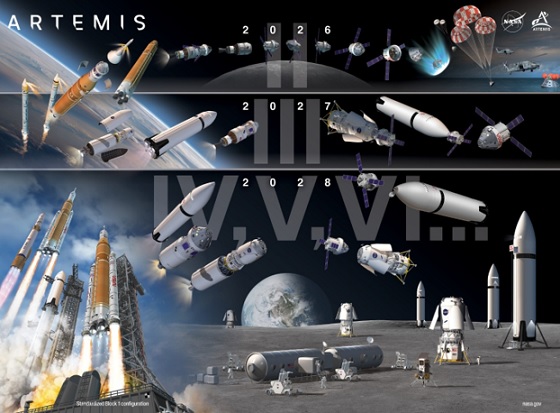
On Feb. 27, Administrator Isaacman laid out a new Artemis schedule to return Americans to the Moon in 2028, or at least before the end of President Trump’s second term.
Full Report . . . . Current Edition . . . . Subscription Information

U.S. SPACECOM among ‘first movers’ in Iran War; Artemis Moon schedule updated added by Editor Two on
View all posts by Editor Two →